How I Pivoted from Pre-Med to UX Without Wasting Years (And How You Can Too)

How I Pivoted Into UX (Without Wasting Years)
I went from doing a thesis in clinical neuropsychology to building a career in UX design and strategy.
Back in first year university, I was your typical pre-med freshman. But then, I fell in love with psychology and specialized in Psychology, Neuroscience, and Behaviour starting my second year. Throughout undergrad, I thought I’d become a psychiatrist or psychologist. But after completing my thesis, I realized something: I didn’t want to spend years in med school or PhD just because it felt like the “next step” or what everyone around me was striving for.
What I did want was:
To work at the intersection of psychology, business, and tech
To make a positive impact at scale
To be creative and strategic
To earn well ($$$) and still have work-life balance
That’s when I stumbled on User Experience (UX), and it just clicked.

The Pivot
After graduating, I took a gap year. Not because I wanted to, but because I needed clarity.
Everyone around me seemed to have their next step figured out. I didn’t. And for a “high-achiever” who always had a plan, that was uncomfortable.
But that year became the most pivotal year of my life.
One conversation with a friend who worked at Shopify changed everything.
I told her I wasn’t sure what I wanted to do yet but I wanted to do something that blended psychology, business, and technology. She said, “That actually sounds like UX.”
Until then, I thought UX was only about design. She explained it could also be research, strategy, and systems thinking — and suddenly, it made sense.
From there, I went all in:
Took online courses to build my portfolio (IDEO.org was my first)
Joined every UX Slack group I could find
Attended local design meetups and conferences across Toronto
Reached out to 50+ people to learn more about the field
Took on volunteer projects at startups to get real experience
Ten months later, I landed my first paid UX role.
And in this guide, I’ll show you how to do it too — without wasting years figuring out the best path forward.
🧭 What’s Inside This Guide
This is your no-fluff, 5-step roadmap to pivoting into UX. Plus lessons learned and an actionable checklist to help you start right away.
Here’s what we’ll cover:
Reality check: Is pivoting into UX still realistic in 2025?
Map your transferable skills: How to connect what you already know to UX.
Upskill smartly: What to learn (and what to skip).
Build your story & portfolio: Even if you have no formal experience.
Network strategically: Get noticed without applying to 100 jobs.
Lessons learned: The biggest mistakes I made so you don’t have to.
Actionable checklist: A 5-step plan to kick-start your pivot this week.
If you’ve been thinking about switching into UX but don’t know where to start — this is is your sign ✨
Your Pivot Roadmap
1. Is pivoting into UX realistic in 2025?
Let’s be honest, the UX job market has become more competitive. There’s higher supply, lower demand, and a flood of people trying to get into tech for the flexibility and remote perks.
But here’s the good news: with the right strategy and mindset, pivoting into UX is still absolutely realistic.
In today’s market:
70–80% of roles are design-focused (think UX Designer, Product Designer)
10–15% are research-focused (UX Researcher, Design Researcher)
The remaining 10–15% are hybrid or adjacent (Service Designer, CX Consultant, UX Writer, Design Strategist).
The essence of UX isn’t about creating sleek designs or uncovering cool insights — it’s about solving real problems for real people in a way that’s sustainable and scalable. A great UXer always understands both the business and the human context behind what they’re solving.
And here’s something many people overlook: UX roles are tech roles. To design sustainable products, you need to understand how technology is built. Get familiar with Agile and Scrum ceremonies, the product development cycle, release cycles, and tools like JIRA. Know what it means to work within a cross-functional, agile team.
If you expect to land a job without learning these fundamentals, you’ll likely struggle.
My best advice?
Adopt a problem-solving mindset. Think deeply about what makes you unique and how you can use those skills to add value.
For example, my mix of:
research background (from a science undergrad)
Master’s in UX Design with a minor in Data Science
strategy experience (from Big 4 consulting) and
digital delivery experience (in GovTech)
…has given me a wide, T-shaped skillset that spans research, design, and product strategy. That T-shape — one deep skill, supported by broad knowledge — is what helps me stand out (and can help you too).
2. Map Your Transferable Skills to UX
Start by asking: What do I already do that translates into UX?
A few examples:
Graphic or motion designer: You already have a strong visual sense — use that to your advantage.
Psychology or science background: You bring analytical and research skills — perfect for UX research and strategy.
Architect: You understand blueprints and systems —ideal for information architecture and user flows.
Developer or computer-science background: You know how products are built —leverage that when thinking about the feasibility of implementing a design.
Make your transferable skills visible — in your portfolio, your LinkedIn headline, and most importantly in how you tell your story.
If you have previous projects from another industry, present them using a design thinking framework (Problem → Process → Outcome). That reframing helps hiring managers immediately see how your skills connect.
3. Upskill Smartly
The fastest way to learn is not by reading more theory — it’s by doing.
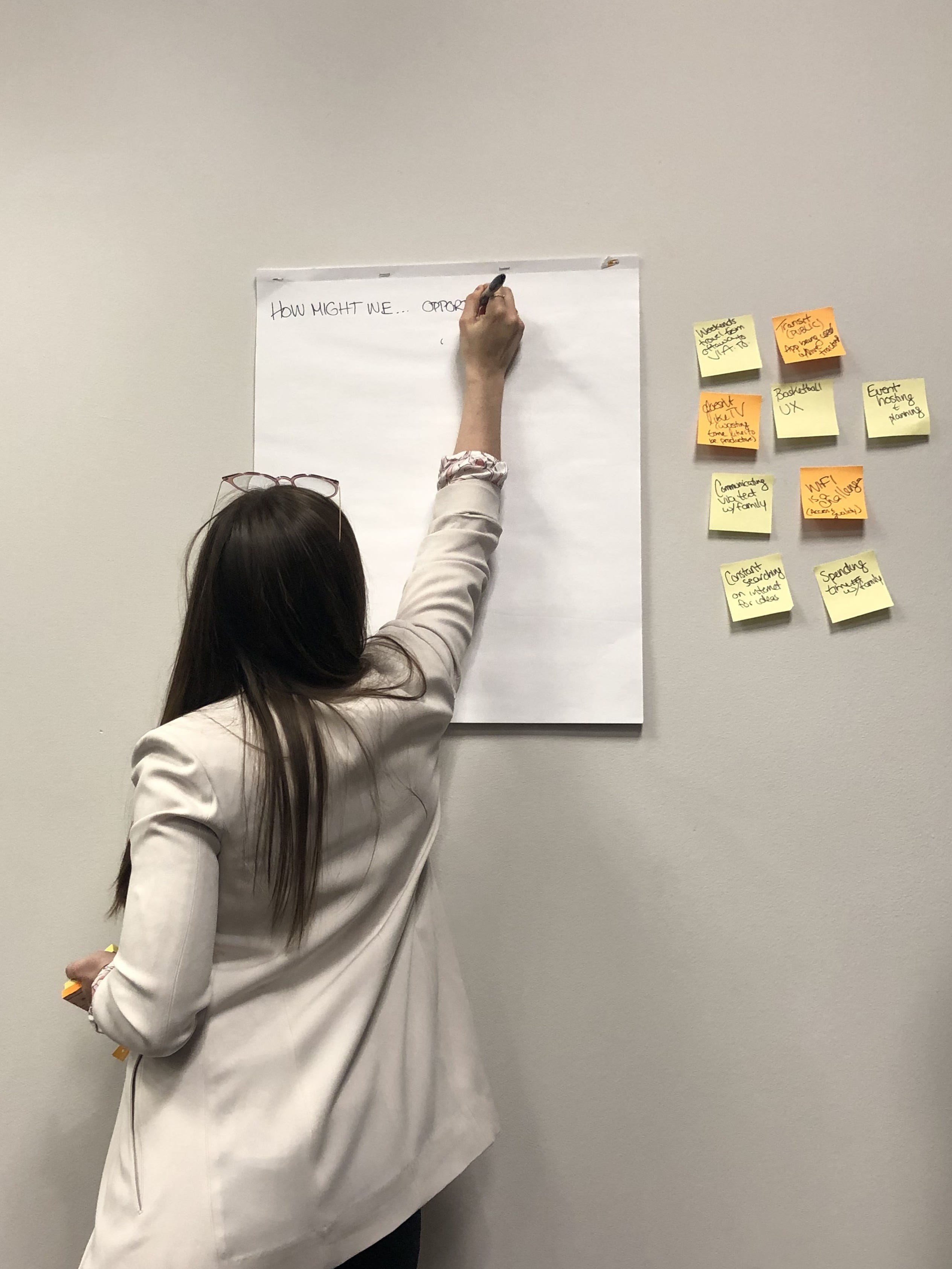
If you don’t have UX experience yet, then I would recommend volunteering with a startup or nonprofit to solve a real-world problem for them. Run through the full design-thinking process:
Empathize: Talk to users and understand the problem.
Define: Identify key user needs and pain points.
Ideate: Brainstorm potential solutions and prioritize by feasibility, desirability, and viability.
Prototype: Build something tangible.
Test: Gather feedback and iterate.
Try to complete these steps in short 1 or 2 week sprints — you’ll learn faster and actually have something to show for your portfolio at the end.
After your first UX project, reflect on where you need to grow. Is it design? Research? Strategy? That clarity will guide you on how to best up-skill.
Depending on your goals, you might:
Do a UX bootcamp → to quickly build design skills and a portfolio.
Pursue a Master’s in UX → to go deep, build a T-shaped skillset, and build a solid network of other UXers.
Self-learn → if you’re disciplined and prefer flexibility.
Each path works — just be strategic. A degree or bootcamp isn’t a golden ticket; what matters is how you apply what you learn.
4. Build Your Story & Portfolio
Once you have 2–3 solid projects on your portfolio, you can start applying.
In fact, keep your portfolio tight — no more than five projects. Focus on clarity and storytelling over quantity.
By the way, for some UX research-based roles you may not need a portfolio to start applying.
Be intentional about crafting your UX story. Ask yourself:
What’s my unique value proposition?
What’s the thread that connects my experiences together?
How can I make my story feel human and memorable?
How can I make myself stand out from other candidates?
Your story is what makes you stand out in interviews and networking conversations. It’s not just about what you’ve done — it’s about why you did it and how it shaped your perspective as a designer or researcher. It’s about the perspective you’ll bring to the company.
Practice your pitch with friends or even people you network with. Ask them for feedback.
5. Network Strategically (Without Applying to 100 Jobs)
Start by narrowing your focus. Identify 3–5 companies you’d love to work for — ones that align with your values and the kind of work you want to do.
Then, start connecting with people who already work there: product designers, UX researchers, PMs, design leads. You can:
Reach out on LinkedIn.
Look for alumni from your university.
Join relevant Slack or community groups.
Your goal from networking isn’t just to “get a job.” It’s to learn:
Am I good fit for this company?
What do they value most in candidates?
What’s the culture really like?
What skills or tools are must-haves for the role you want?
Is this company a good fit for me?
Networking also helps you learn the language of the industry. You’ll start to notice how professionals talk about their work — and that can help you sound more credible in interviews.
If you can, get a referral — it significantly increases your chances of landing an interview.
I once knew someone who spoke with nearly everyone on our design team before applying. By the time interviews rolled around, the entire team was already rooting for her.
Lessons Learned: Mistakes I Made So You Don’t Have To
Don’t apply to 100 jobs aimlessly.
Focus on quality over quantity. Tailor your story to the 3–5 companies that truly excite you.Craft a story that’s true to you.
Don’t copy someone else’s narrative. Lean into what makes your journey unique.Be relentless but reflective.
When things don’t work out, don’t spiral instead analyze why. Is it your portfolio, lack of experience, or weak networking? Then, fix it.Don’t collect credentials without intention.
Another bootcamp or course won’t automatically make you more employable. Learn, network and apply strategically.
Actionable Checklist: Your 5-Day Pivot Plan
Day 1: Learn the basics.
Ask ChatGPT: “I’m a beginner pivoting into UX — teach me the core principles and terminology.” Take notes on concepts like user research, wireframing, usability testing, and design thinking.
Day 2: Reflect on your transferable skills.
Write down what you already know, what you need to learn, and how you can bridge those gaps.
Day 3: Find real projects.
Search for startups, nonprofits, or hackathons that need UX help. Apply design-thinking principles right away.
Day 4: Build your first mini-case study.
Document what problem you solved, how you approached it, and what impact it made.
Day 5: Start networking.
Reach out to three people working in roles you admire. Be curious, ask smart questions, and start building genuine connections.
If you take one thing from this guide, let it be this:
UX isn’t just a job title — it’s a mindset. The more you approach problems with curiosity, empathy, and strategy, the faster you’ll grow into the kind of designer or researcher every team wants.